

Heat Pump Repair Warning Signs: Test Heating Mode Before Anaheim’s Cool Nights
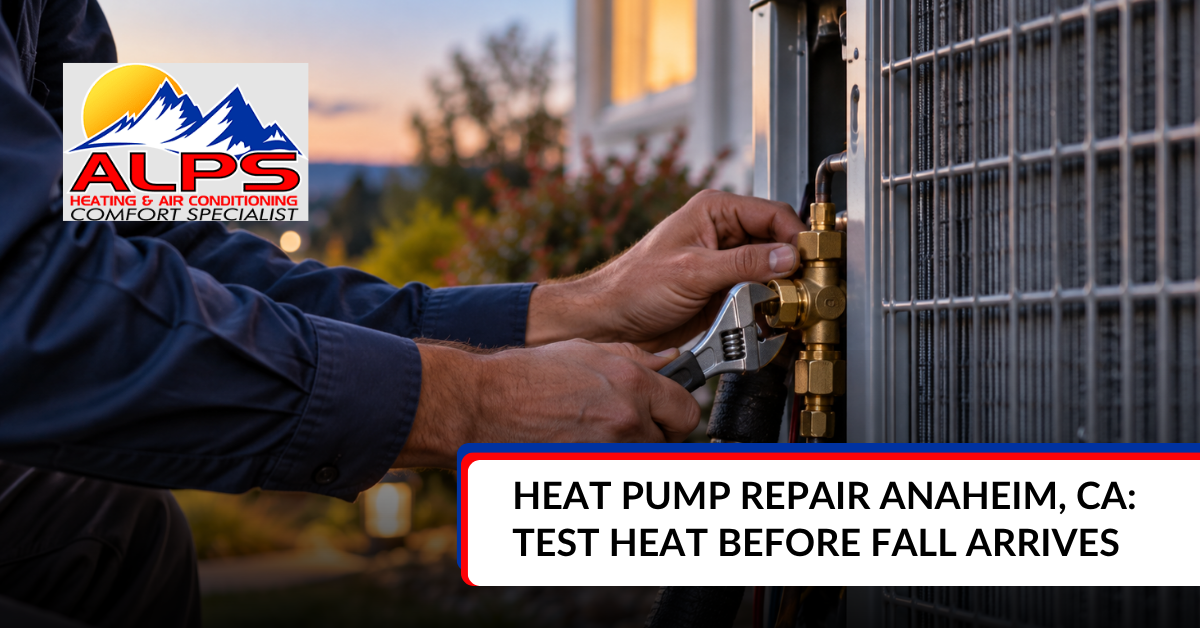
A heat pump that cooled normally all summer can still have a thermostat, control, reversing valve, refrigerant, airflow, or electrical problem that appears only in heating mode. Set the thermostat to HEAT, raise the setting a few degrees above room temperature, and allow the system time to complete a heating cycle. If the home does not begin warming, the air stays genuinely cold, or the system will not start, schedule professional heat pump repair instead of opening the equipment yourself.
You probably have not thought much about heating yet. Your heat pump kept the house comfortable through July and August, and September afternoons in Orange County can still feel like summer.
Then a cool morning arrives. You switch the thermostat from COOL to HEAT, hear the system start, and wait. The vents keep blowing cool air.
That is exactly why September is a smart time to perform a simple heating-mode check. A heat pump uses many of the same components for cooling and heating, but it must reverse its refrigerant cycle to heat your home. A system can therefore cool correctly all summer and still needheat pump repair when asked to change modes.
Anaheim’s 1991 to 2020 climate normals show a September average high of 87.8°F and low of 64.1°F. October averages 83.4°F and 59.3°F. That gives homeowners a useful window to find heating problems before cooler nights become more frequent.
This guide explains what to test, what normal heat pump operation feels like, and when it is time to schedule professional service.
Why a Heat Pump Can Cool Fine but Fail in Heating Mode
A heat pump does not create heat the same way a gas furnace does. During summer, it transfers heat from inside your house to the outdoors. And, during winters, it reverses that process and transfers available heat from outdoor air into the house. The U.S. Department of Energy describes heat pumps as systems that move heat rather than generate it directly.
The component that makes the seasonal change possible is the reversing valve. This valve changes the direction of refrigerant flow so the indoor coil can release heat instead of absorbing it.
| Cooling Mode | Heating Mode |
|---|---|
| Indoor coil absorbs heat | Indoor coil releases heat |
| Outdoor coil rejects heat | Outdoor coil absorbs outdoor heat |
| Reversing valve directs cooling cycle | Reversing valve shifts refrigerant flow |
| Thermostat calls for cooling | Thermostat calls for heating |
A failed mode change does not automatically mean the reversing valve itself is bad. Several conditions can produce similar symptoms.
Common Causes of a Failed Heating Test
A thermostat may fail to send the correct heating signal. The reversing valve or its solenoid can fail to shift. Low refrigerants can reduce heating output even when cooling seems acceptable during warmer weather.
Control boards, wiring, capacitors, compressors, indoor blowers, and outdoor fans can also create heating problems.
That efficiency depends on every part of the system operating correctly, which is why the symptoms during your first heating test matter.
Heat Pump Warning Signs You Should Never Ignore
A September heat pump heating mode test is useful because you can observe the system without waiting for a cold-weather emergency.
Watch for these specific warning signs:
- The heat pump never switches to heating. The system runs, but the air feels like active air conditioning rather than warmer-than-room air.
- The thermostat says HEAT but nothing starts. A thermostat, low-voltage control, breaker, disconnect, safety control, or equipment problem may be preventing operation.
- The heat pump keeps starting and stopping. Short cycling can point to controls, airflow restrictions, electrical faults, improper sizing, or refrigeration issues.
- The outdoor unit does not run. Depending on system design and thermostat call, an inactive outdoor unit can indicate an electrical, control, or equipment problem.
- The breaker trips when heating starts. Stop repeatedly resetting it. A recurring trip deserves electrical diagnosis.
- Airflow is unusually weak. A dirty filter, blower problem, blocked return, duct restriction, or dirty coil can interfere with heating performance.
- The house never gets warmer. Heat pump air often feels less hot than furnace air, but the indoor temperature should still move toward the thermostat setting.
Do not diagnose a failed reversing valve based only on how the air feels against your hand. Heat pump supply air is usually gentler than furnace discharge air.
Carrier also identifies cold air in heating mode, constant operation, and outdoor-unit icing among common heat pump troubleshooting complaints.
HVAC Advice: Watch the thermostat temperature over a complete cycle. The home’s actual temperature trend tells you more than a five-second hand test at one vent.
If those symptoms appear in September, addressing them now is usually easier than discovering them on the first cool November evening.
What Happens If You Wait Until the First Cold Night
A failed September test does not mean your house is in immediate danger. In Orange County’s mild climate, the larger concern is allowing a known problem to remain hidden until you actually depend on the system.
The first consequence is comfort. An intermittent thermostat or reversing valve problem may become a no-heat call when overnight temperatures finally drop.
The second is operating cost. A heat pump that cannot deliver its normal heating capacity may run longer than expected. Some systems may also rely more heavily on auxiliary resistance heat when there is a performance problem.
A third concern is repair escalation. A relatively straightforward control, capacitor, thermostat, or airflow problem can place additional stress on other components if the system keeps operating abnormally.
There is also a practical scheduling issue. A planned heat pump repair Orange County appointment during mild weather gives you more flexibility than a no-heat call when seasonal demand suddenly increases.
Do Not Do This: Do not keep cycling the thermostat between heating and cooling every few seconds to force a reversing valve to move. Give the equipment time to stop and respond normally to each thermostat command.
The good news is that homeowners can perform a useful September check without touching refrigerant, electrical panels, or internal components.
DIY September Heat Pump Test vs. Calling a Licensed HVAC Contractor
A homeowner heating-mode test should be observational. You are confirming whether the system responds correctly, not trying to repair internal equipment.
What You Can Handle
Use this simple checklist:
- Check the filter and replace it if visibly dirty.
- Make sure supply vents and return grilles are open and unobstructed.
- Set the thermostat fan to AUTO.
- Change the operating mode from COOL to HEAT.
- Raise the setpoint about 3°F above the current indoor temperature.
- Give the system about 10 to 15 minutes to establish operation.
- Confirm that airflow is steady and the indoor temperature begins moving upward.
ENERGY STAR recommends selecting HEAT or COOL rather than relying on AUTO mode when you want to control seasonal heat pump operation. It also recommends keeping filters clean.
When You Must Call a Pro
Call for heat pump repair near youwhen you have repeated breaker trips, internal electrical problems, refrigerant issues, a suspected reversing valve fault, compressor problems, control-board failures, or persistent no-heat operation.
EPA regulations require Section 608 certification for technicians performing work that can release refrigerant from stationary air-conditioning and heat pump equipment.
California also requires contractor licensing when work requires a permit, uses employee labor, or totals $1,000 or more in combined labor and materials.
Safety Notice: Working on gas lines, main sewer systems, or any HVAC connected to electrical components should only be performed by a licensed professional. Improper repairs can result in gas leaks, sewage contamination, electrical hazards, or voided homeowner’s insurance. If you suspect a gas leak, leave the building immediately and call your gas utility’s emergency line.
If your safe homeowner test fails, the next step should be diagnosis rather than parts swapping.
Your Heat Pump Failed the September Test?
Alps Heating & Air Conditioning provides heat pump repair, replacement, and related HVAC service in Anaheim and surrounding Orange County communities. Its current heat pump page states that technicians handle heat pump repair and replacement across makes and models.
Call 714-617-7860 and ask about current scheduling if your system will not switch into heating mode.
How Professional Heat Pump Repair Works Step by Step
A professional should determine whether the failed heating test comes from the thermostat, airflow, controls, refrigeration system, or reversing function before recommending a major repair.
1. Confirm the Complaint, About 5 to 10 Minutes
The technician reviews what happened during your heating test. They confirm thermostat mode, setpoint, indoor temperature, system history, noises, airflow, and whether cooling worked normally.
2. Test Thermostat and Control Signals, About 10 to 20 Minutes
A technician can verify whether the thermostat is actually sending the correct heating and reversing-valve commands. This prevents an expensive component from being blamed for a simple control problem.
3. Inspect Airflow and Electrical Operation, About 15 to 30 Minutes
The technician evaluates the filter, blower, indoor coil, outdoor fan, capacitor, contactor, electrical connections, and other accessible components.
Tools may include a digital multimeter, clamp meter, temperature probes, static-pressure instruments, and manufacturer diagnostic software.
4. Evaluate the Refrigeration Cycle, About 20 to 45 Minutes
If needed, an EPA-certified technician checks refrigerant pressures and temperatures and determines whether the system is transferring heat correctly.
5. Test the Reversing Function, About 15 to 30 Minutes
If the heat pump is not switching to heat, the technician determines whether the reversing valve is receiving the proper control signal and whether the valve is actually shifting.
6. Present the Repair Options
You should receive the diagnosis, repair recommendation, price, applicable warranties, and any replacement discussion before authorizing major work.
That process matters because heat pump symptoms overlap. A failed thermostat can look like a valve problem, while low refrigerant can look like weak heating.
Once the diagnosis is known, homeowners can make a much better repair-versus-replacement decision.
Heat Pump Repair Cost in Orange County in 2026
There is no single accurate price for heat pump repair without identifying the failed component.
Current 2026 national repair data from Angi places many common components within the following ranges. These figures are budgeting benchmarks, not an Alps estimate and not guaranteed Orange County prices.
Your actual heat pump repair cost in Anaheim can change based on system age, refrigerant type, warranty status, accessibility, manufacturer parts availability, emergency scheduling, and how much diagnostic work is needed.
A legitimate estimate should identify the failed component, labor, parts, warranty coverage, cleanup, and permit-related work when applicable.
For an expensive repair, ask for both repair and replacement options. Alps currently offers heat pump replacement and financing on approved credit, according to its heat pump service page.
Red Flag: A technician should be able to explain why a reversing valve, compressor, or refrigerant repair is needed. Be cautious when a large repair is recommended without measurements or diagnosis.
Cost is important, but the contractor performing the diagnosis matters just as much.
How to Choose a Heat Pump Repair Company in Anaheim
Searching heat pump repair near me can produce a long list of contractors. Start with qualifications that can be verified.
1. Check the California Contractor License
Use the California Contractors State License Board license-check system. CSLB advises consumers to verify a contractor’s current license before hiring.
For HVAC work, look for the appropriate classification. California’s C-20 classification specifically includes heating, ventilation, air conditioning, ducts, controls, and related systems.
2. Ask About Refrigerant Credentials
If diagnosis or repair involves the sealed refrigerant circuit, ask whether the servicing technician holds EPA Section 608 certification.
3. Look for Relevant Technical Training
NATE certification and manufacturer training can be useful signals. Alps’ current website states that it employs NATE-certified HVAC technicians and services multiple heating and cooling system types.
Manufacturer dealer relationships with brands such as Lennox, Daikin, Mitsubishi Electric, Trane, or others may also indicate product-specific training. Verify the contractor’s current designation rather than relying on an old badge.
Ask whether the contractor is bonded and appropriately insured. BBB accreditation, trade-association membership, Google reviews, Yelp reviews, and Nextdoor recommendations can provide additional context, but none replaces licensing and competent diagnosis.
A locally established contractor can also bring familiarity with Anaheim permitting, utility programs, climate conditions, and common Orange County housing configurations. Judge any company on documented credentials, service quality, and recent customer experience.
Those factors become even more relevant when you plan preventive heat pump service instead of waiting for a breakdown.
September Heat Pump Maintenance Before Heating Season
September is unusual in Anaheim because you may still rely on cooling during the afternoon while beginning to think about heating at night.
NOAA’s long-term climate normals illustrate the transition. Anaheim’s average September high is 87.8°F, while the average low is 64.1°F. By November, the average high falls to 76.8°F and the average low to 53.0°F.
That makes a mild September morning or evening a practical time for a heat pump tune up Orange County homeowners can complete before heating demand increases.
Fall Heat Pump Checklist
- Run one complete heating-mode test before you actually need heat.
- Replace or clean the air filter when required.
- Keep indoor returns and supply registers clear.
- Remove loose leaves and debris from around the outdoor unit.
- Listen for new buzzing, grinding, rattling, or repeated clicking.
- Watch for unusually frequent cycling.
- Schedule professional maintenance if the system has skipped routine service.
A properly operating heat pump should produce steady heating rather than furnace-like blasts of very hot air. If you previously owned a gas furnace, do not mistake gentler heat pump supply air for failure.
ENERGY STAR recommends maintaining clean filters and generally holding a steady thermostat temperature with heat pumps rather than using aggressive temperature setbacks.
A professional heat pump maintenance Anaheim CA appointment can also catch electrical wear, airflow problems, controls issues, and refrigeration concerns before winter operation.
The final piece is understanding the local rules and incentives that can affect repairs, replacement, and installation decisions.
Anaheim and Orange County Heat Pump Factors for 2026
For an air-source heat pump, Orange County water hardness is not a meaningful operating factor. Water quality matters for water heaters and hydronic equipment, but the relevant local factors for a residential air-source heat pump are climate, electrical service, permits, energy rules, and utility incentives.
California’s 2025 Energy Code Is Now Active
California’s 2025 Building Energy Efficiency Standards became effective for applicable permit applications on January 1, 2026. The update encourages heat pumps in new residential construction and applies updated HVAC requirements to covered additions and alterations.
Anaheim states that the 2025 California Building Codes and city amendments apply to residential and nonresidential projects submitted on or after January 1, 2026. Anaheim is identified as Climate Zone 8.
Anaheim Public Utilities Has Heat Pump Incentives
The Anaheim Public Utilities Home Incentives Program application updated April 27, 2026 lists qualifying heat pumps and heat pump mini-splits meeting specified efficiency requirements, including 14.3 SEER2 or 15 SEER+. Applications must meet program rules and eligibility requirements.
That matters when a major heat pump repair Anaheim CA estimate causes you to consider replacement instead.
Alps’ current service-area page includes Anaheim, Brea, Fountain Valley, Fullerton, Irvine, Placentia, Tustin, Villa Park, and Yorba Linda among its Orange County communities.
Permit rules and utility incentives can differ by city, so homeowners outside Anaheim should verify requirements with their own jurisdiction or utility before beginning a heat pump installation or replacement.
Homeowners Also Ask About Heat Pump Heating Problems
Can a heat pump cool normally but fail to heat?
Yes. Heating and cooling share major components, but switching modes requires the system to reverse the refrigerant cycle. A thermostat signal, reversing valve, control problem, refrigerant issue, or another component can therefore affect heating differently from cooling. A successful summer does not guarantee that the first fall heating cycle will work correctly.
Why is my heat pump blowing cold air in heat mode?
First confirm that the thermostat is set to HEAT and the fan is set to AUTO. Heat pump air may feel less hot than furnace air, so check whether the room temperature is actually increasing. Carrier notes that thermostat settings, normal defrost operation, restricted airflow, and equipment problems can all cause homeowners to report cool air in heating mode.
What does a reversing valve do in a heat pump?
The reversing valve changes the direction of refrigerant flow. That allows one system to remove heat from the house in summer and move outdoor heat into the house during heating season. If the valve or its controls fail, a heat pump may remain stuck in one operating mode. ENERGY STAR describes an air-source heat pump as essentially providing both heating and cooling by reversing how heat moves through the system.
When should I test my heat pump before winter in Orange County?
September or early fall is a useful time because cooling season is winding down, but Orange County weather is generally still mild. Test on a cooler morning or evening when you can raise the thermostat enough to create a real heating call. Finding a problem now gives you time to schedule heat pump service before the first period when you truly depend on heating.
Frequently Asked Questions
Q: How long does heat pump repair usually take?
A: A thermostat, capacitor, contactor, or basic control repair may sometimes be completed during the initial visit when the correct part is available. Refrigerant leak repairs, reversing valves, coils, compressors, or difficult electrical problems can require several hours or a return visit. Your technician should explain the diagnosis, estimated repair time, and parts availability before major work begins.
Q: Does a bad reversing valve always mean I need heat pump replacement?
A: No. A reversing-valve problem is repairable on many systems. The decision depends on equipment age, condition, warranty coverage, refrigerant type, repair cost, efficiency, and whether other major components are deteriorating. Alps’ heat pump page notes that technicians can evaluate both repair and replacement options when diagnosing an existing system.
Q: Do heat pump repairs require a licensed California contractor?
A: California requires contractor licensing when a project requires a permit, involves employee labor, or totals $1,000 or more in labor and materials. Refrigerant circuit work also triggers separate federal technician certification requirements under EPA Section 608. Verify contractor credentials through CSLB before authorizing significant HVAC work.
Q: What warranty should I expect after heat pump repair?
A: Warranty terms differ by contractor, replacement part, manufacturer, and equipment age. Ask which parts are covered, whether labor is included, how long coverage lasts, and whether maintenance requirements affect the warranty. California CSLB consumer guidance recommends getting warranties for labor and materials in writing when they are offered.
Ready to Know Your Heat Pump Will Heat Before You Need It?
Cooling all summer does not prove that your heat pump is ready for the winter season. A simple September mode-change test can expose thermostat, airflow, electrical, refrigerant, or reversing-valve problems while Orange County weather is still mild.
For heat pump repair in Anaheim, CA, Alps Heating & Air Conditioning provides heat pump repair, replacement, and home-comfort service throughout Anaheim and surrounding Orange County communities. Alps is family-owned, its current website states that the company uses experienced HVAC technicians, and its heat pump page says the team services heat pump makes and models throughout the area.
Call Alps Heating & Air Conditioning at 714-617-7860 to schedule heat pump service or ask about current repair availability.
Serving homeowners in Anaheim, Villa Park, Brea, Fullerton, Placentia, Yorba Linda, Irvine, Fountain Valley, Tustin, and surrounding Orange County communities.